PFAS in Your Kitchen: Non-stick Pans and Beyond

We all love that magical moment when eggs slide right out of the pan without a speck of stick. For decades, non-stick cookware has been a kitchen superhero. But have you ever stopped to wonder what makes it so slippery?
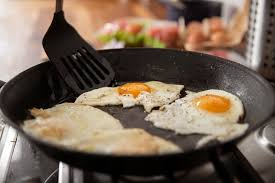
Nonstick cookware contains PFAS
The answer often involves a group of chemicals called PFAS (per- and polyfluoroalkyl substances). These synthetic compounds have earned the nickname "forever chemicals" for good reason: they do not break down easily, and they have been found to linger far beyond our frying pans.
We all want our kitchens to be a place of health and nourishment. Yet, if you look around any modern kitchen, you will likely find non-stick pans promising easy clean-up, stain-resistant placemats, and grease-proof takeout containers. These conveniences share an invisible common thread; they are often treated with these same PFAS.
As endocrine disruptors, these chemicals can interfere with our body’s natural hormones, leading to concerns about long-term health. The good news? You do not need to throw out everything in your pantry today. Understanding where these chemicals hide is the first step, and a few simple swaps can make a world of difference.
What Are PFAS and Why Do They Matter?
PFAS are a family of thousands of human-made chemicals engineered to repel water, oil, and heat. This "superpower" makes them incredibly useful for manufacturers, but it comes at a cost.
Their molecular structure - specifically the incredibly strong carbon-fluorine bonds - makes them nearly indestructible. This is why they are nicknamed "forever chemicals"; they simply do not break down easily in the environment or in our bodies.
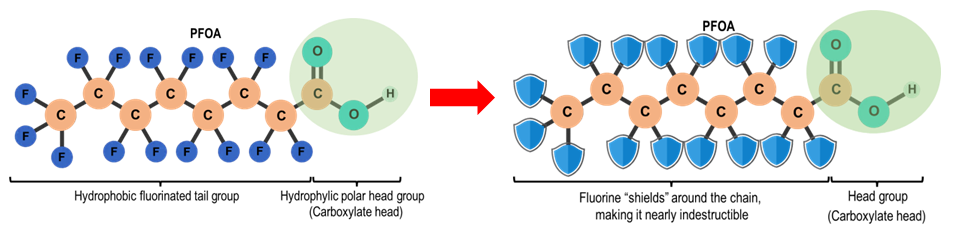
Carbon-fluorine bonds make PFAS nearly indestructible
For decades, these chemicals have been the "secret ingredient" in making products non-stick, stain-resistant, and grease-proof. While the most famous version, PFOA (perfuorooctanoic acid) (formerly used to make Teflon), was largely phased out in the U.S. due to health concerns, however, thousands of similar PFAS chemicals are still in use today.
PFAS Acronyms Explained
Acronym | Full Name | Notes |
PFAS | Per- and polyfluoroalkyl substances | Large family of synthetic chemicals, often called “forever chemicals.” |
PFOA | Perfluorooctanoic acid | Once widely used in Teflon™ and stain-resistant products; linked to cancer and immune disorders. |
PFOS | Perfluorooctanesulfonic acid | Common in firefighting foams, stain-resistant fabrics, and food packaging; highly persistent and toxic. |
PTFE | Polytetrafluoroethylene | Best known under the trade name Teflon, used in non-stick cookware, wiring insulation, and industrial applications because of its chemical inertness and slippery surface. |
Where PFAS Hide in Your Kitchen
The kitchen has historically been a primary source of PFAS exposure. Manufacturers began phasing out PFOA after 2013; one of the most concerning types of PFAS. However, many traditional non-stick coatings still rely on other chemicals within the same "forever chemical" family.
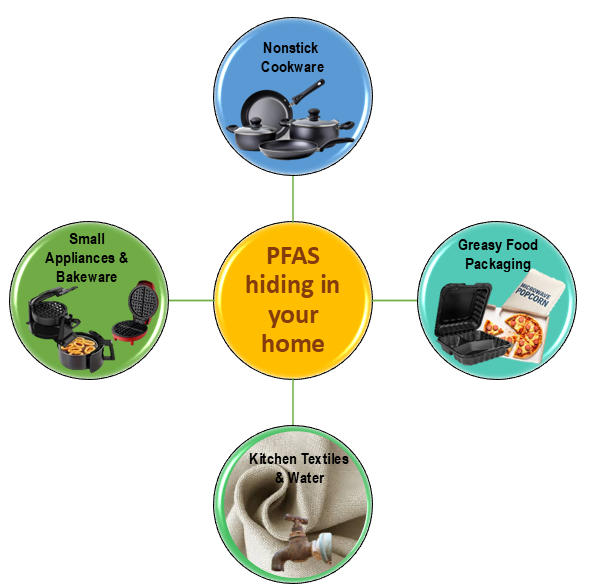
Here is where they might still be hiding in your home:
- Non-stick Cookware: The Primary Source
This is the big one. Traditional non-stick pans (often labelled as Teflon) use PTFE, a type of PFAS, to create that slippery surface. The risk to your health increases if the coating is:
- Scratched or chipped: Releasing microscopic particles directly into your food.
- Overheated: When heated above 500°F (260°C), these coatings can begin to break down and release toxic fumes into the air.
- Greasy Food Packaging
Have you ever wondered why grease does not soak through a fast-food wrapper or a pizza box? It is often thanks to a PFAS-based coating. Common culprits include:
- Microwave popcorn bags: Historically a major source of exposure due to the high heat and oil.
- Takeout containers: Including some compostable "eco-friendly" bowls (unless they are specifically labelled PFAS-free).
- Pizza boxes: Often treated to prevent oil seepage.
- Small Appliances & Bakeware
It is not just frying pans. Many smaller kitchen gadgets use the same non-stick technology:
- Air fryer baskets: Most standard air fryers use a non-stick coating that can wear down over time.
- Waffle makers and griddles: Frequently coated in PTFE.
- Baking sheets: Many "easy-release" cookie sheets are treated with PFAS.
- Kitchen Textiles and Water
- Stain-resistant linens: Tablecloths, napkins, or even aprons marketed as "stain-proof" or "spill-resistant" are often treated with PFAS.
- The water supply: If your local water source is contaminated, it can be a significant point of exposure. It is always a good idea to check your local water quality report.
Why Should We Care?
PFAS do not just stay in the products, they can migrate into food, especially when cookware is overheated or packaging comes into direct contact with hot meals. Over time, these exposures add up.
Why should we be concerned? From a biological perspective, PFAS act as "hormone mimics" and interfere with our hormone systems. Because they accumulate in our bodies over time and are eliminated very slowly, even low-level chronic exposure is concerning. Research has linked PFAS exposure to:
- Altered thyroid function
- Reduced fertility
- Impacts on metabolism and immune function
- Developmental delays in children
- Increased cholesterol levels
- Hormone-related cancers
Pregnant women and young children are particularly vulnerable, as PFAS can cross the placenta and appear in breast milk, potentially affecting foetal development and child growth.
While the science on every single PFAS is still evolving, the concerning evidence has led many health experts to recommend a precautionary approach: it is wise to reduce exposure where we reasonably can.
Making Safer Choices
Reducing your exposure to PFAS is a journey of making intentional, straightforward swaps. By focusing on the materials that come into contact with your food, water, and skin, you can significantly lower your daily chemical burden.
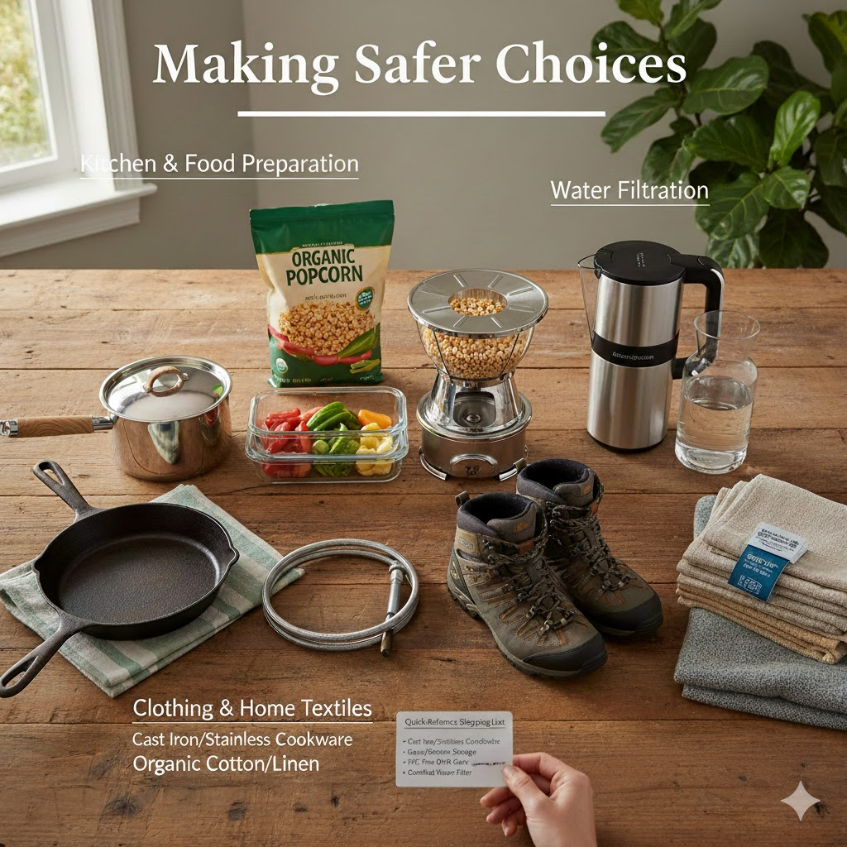
Making Safer Choices
Kitchen and Food Preparation
The kitchen is often the primary source of PFAS exposure. Moving away from non-stick coatings and treated packaging is a powerful first step.
Category | What to Avoid | Safer Alternatives |
Cookware | Traditional non-stick pans (Teflon) | Cast iron, stainless steel, or ceramic-coated (verify PFAS-free) |
Food Storage | Grease-proof or stain-resistant containers | Glass, stainless steel, or silicone containers |
Snacks | Microwave popcorn bags | Stovetop or air-popped popcorn |
Groceries | Heavily packaged or processed foods | Fresh, whole foods with minimal packaging |
- Dining Tip: When ordering takeout, transfer food to your own ceramic plates immediately to minimise the time hot food spends in contact with potentially treated wrappers.
Water Filtration
Standard tap water can contain trace amounts of PFAS. For the best protection, use filtration systems certified under NSF/ANSI 53 or 58.
Technology | Effectiveness | Best For | Pros/Cons |
Reverse Osmosis | Highest (94–99%) | Drinking and Cooking | + Most effective for short-chain PFAS; - Higher cost |
Activated Carbon | High (76–90%) | Pitchers and Under-sink | + Affordable and easy; - Filters must be changed regularly |
Ion Exchange | High | Whole-house systems | + Great for high volume; - Requires professional installation |
Clothing and Home Textiles
PFAS are frequently used to make fabrics waterproof or stain-resistant. Look for natural fibers and specific "PFC-free" labels.
Category | What to Avoid | Safer Alternatives |
Outdoor Gear | Standard "DWR" (durable water repellent) waterproof finishes | Brands using PFC-free DWR (e.g., Patagonia, Mammut) |
Everyday Wear | Stain-resistant or wrinkle-free cotton | Organic cotton, hemp, linen, or Tencel |
Footwear | Chemically waterproofed leather/mesh | PFAS-free brands (e.g., Allbirds, Keen) |
Furniture | Fabrics treated with Scotchgard/Teflon | Untreated natural fabrics or "Revolution" PFAS-free fabrics |
How to Identify Safe Products
To ensure you are truly making a safer choice, look for these specific markers on product labels:
- PFAS-Free / PFC-Free: Look for these explicit claims on labels.
- OEKO-TEX® Standard 100: Indicates the textile has been tested for harmful substances.
- Bluesign®: Signifies the product was manufactured with the lowest possible impact on people and the environment.
- The Bead Test: If water beads up and rolls off a fabric instantly, it likely has a PFAS coating unless the brand specifies otherwise.
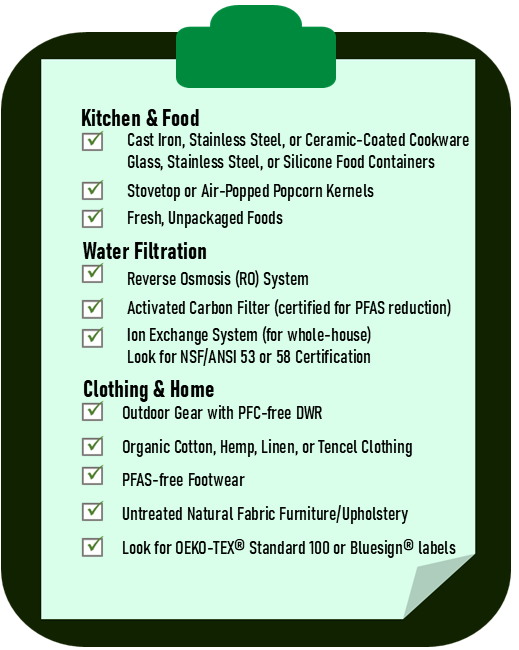
Quick-Reference PFAS free Shopping List